Harry Potter And The Methods Of Rationality

A wonderful, wonderful book. I only wish I could read it earlier. This is likely one of the very best books I ever read. The “Harry Potter And The Methods Of Rationality” is very loosely based around the original characters and environments set by J.K.Rowling but really is a completely different book. And, at that, a much better book it is. Of course, this book would be hardly suitable or understood in full by the children before they at least have a solid understanding of logic and a little of various sciences. For adults, this is a feast. I will not go into any detail of the plot and characters, they are all amazing and the book is full of surprises. It’s best if you discover it yourselves. I will simply highly recommend you do discover it indeed.

The book is available here: https://www.fanfiction.net/s/5782108. Go read it if you did not yet, you will not be disappointed.

A local copy in PDF is available. A local copy in EPUB is available.… -->

continue reading →

John Scalzi, “Old Man’s War”

I happened to come across an interesting title, as it happens to me sometimes, and I did not feel sorry a bit for reading the “Old Man’s War” by Jouh Scalzi. It was so good, I actually went on and read the sequel, “The Ghost Brigades”. Strangely, that did not disappoint me either. The writer is surprisingly good and I was not able to predict the turns of the plot, which makes for a very exciting reading. Well, sometimes you do go “oh, damn, I wish he didn’t do that” but it’s the author’s cruel world and he is the king.

The writing style is very much reminiscent of that of Robert Heinlein, whom I love to read. Author even acknowledges pretty much that Robert Heinlein was an inspiration to him. The last sentence reads “Thank you, Robert A. Heinlein, for debts that have … become obvious.” I have to say John Scalzi lives up to the expectations, albeit being far more cautious and less provocative than Heinlein. All in all, a highly recommended, very entertaining reading in the Sci-Fi genre with plenty of interesting ideas interspersed with action.… -->

continue reading →

Robert M. Pirsig, “Zen and The Art of Motorcycle Maintenance. An Inquiry into Values.”

“The real cycle you’re working on is a cycle called yourself.”

One more completely misrepresented book in our world. This book is typically described as a “travel book”, meaning that it contains a travel description, which it is anything but. This is, au contraire, a philosophical treatise explaining the intellectual path to the enlightenment and the state of human “grown-up”. And as the first quote rightly sums it up, the book is about working on yourself and not about motorcycles.

Pirsig claims that he took the name Phaedrus accidentally, meaning to take the Greek word for “wolf” but ending with “bright” by accident. With all due respect, I don’t believe in accidents. “Phaedrus” stands for “enlightened” and that is who he is. The book contains interesting allegories that explain well how the human awareness comes to existence, how we perceive the world, and how we do it all wrong.

We take a handful of sand from the endless landscape of awareness around us and call that handful of sand the world.

The book has a lot in common with other philosophical and mystical books in that it also describes the path to the enlightenment that a person must take. The path that results in discarding of ego, discarding the very idea of who you are and unlearning everything you learned to start understanding the world.

He wanted to free himself from his own image. He wanted to destroy it because the ghost was what he was and he wanted to be free from the bondage of his own identity. In a strange way, this freedom was achived.

And all of the wisdom is described in a very natural (for our culture) “scientific” language that rings true to the ears of the modern man. The examples are everyday things that one can easily relate to and analogies have true meaning for the man of today. This scores a lot of points when compared to somewhat cryptic Eastern books or works of Carlos Castaneda.

One of the important things that the book mentions is a clear distinction between the glorified self-interest and the true growing-up, the true desire of enlightenment. That self-glorification is the disaster of the today’s world.

Any effort that has self-glorification as its final endpoint is bound to end in a disaster. […] When you try to climb a mountain to prove how big you

--> continue reading →

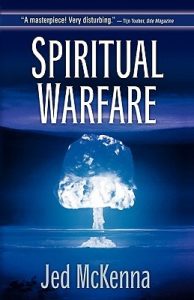
Jed McKenna, “Spiritual warfare”

The human race isn’t defective, it’s just broken.

I often state that the knowledge comes whenever we are ready to receive it. For me, most of the knowledge comes as books. I seem to nearly always have the right book that tells me exactly what I want to know at the moment.

This book is beyond belief. It is so true that it invalidates any and all criticism that I may have had for the second book of the trilogy. From my perspective, the second book was weak and purposeless, with many anecdotes and little substance. This, the third book, remedies all that with a vengeance.

This book not only reaffirmed my own thoughts and ideas on the subject of spirituality and enlightenment but also brought some new ideas and information that I have not considered before.

Scoop a jar of water out of the ocean and put a lid on it. Study it in its segregated state. Where is the ocean in that jar? Where are the tides and the currents? Pour it back into the ocean and it returns to its integrated state. The temporary entity no longer exists. By scooping it into a jar, you’s created a new entity, a sub-ocean. It’s not possible to subdivide infinity, of course, but try telling that to your new entity. It has all the properties of the ocean from which you scooped it, in no way greater or lesser than any other sampling you might take, yet it bears little resemblance to its authentic oceanhood. It has an independent existence, yet as soon as you pour it back, it merges seamlessly back into the integrated whole. Where is that particular sub-ocean entity after you pour it back in? The same place it was before: everywhere and nowhere. It didn’t exist before you scooped it up, but you didn’t create it. It doesn’t exist after you pour it back, but you didn’t destroy it. So what was born when you segregated that jarful? What died when you reintegrated it?

Most importantly, the book contains what amounts to practical advice in so far as such can be given and that makes its value even higher. An excellent read and an excellent source.

 … -->

continue reading →

Jed McKenna, “Spiritually Incorrect Enlightenment”

The sequel to the “Spiritual Enlightenment: The Damnedest Thing” turned out to be quite entertaining but less well written. Frankly, at times it felt like one of those sequels written purely for the sake of money, knowing that the folks that bought the first one will likely buy the next one. There are some interesting stories but the book feels on one side very commercial while on the other rather undercooked. If the first book left no doubt that the person can be trusted, the second raises the question of whether we are in for some bullshit. That’s the feeling I get, anyway.

Still, towards the end the book things seem to clear up a lot and it gets interesting. Especially I liked the discussion of the essence of the fight for enlightenment:

Fear vs. Hate. Fear of No-Self vs. Hatred of False-Self.

That about sums it up for me. And the other quite interesting discussion was related to the attitude towards death:

That’s what death is, guaranteed absolution; freedom and forgiveness all in one. If you understand the fact of your own death, that it’s always here with you and that it’s a certainty, then you’re free. That’s liberation; knowing that nothing is yours or can be yours, knowing that you have nothing to lose.Other people push death away, deny it, but we don’t have that luxury. We have to pull death close, embrace it, carry it in our hearts and minds. I don’t mean like a college kid getting stoned and having a one-night stand with existentialism, I mean like something you carry in your pocket and always have one hand on.

This looks just like Castaneda’s definitions and discussions. Might be coming from there, might be just true. Anyhow, this state of taking in the death as your friend seems a pretty powerful weapon if you dare take it up.

Overall, less enjoyable than the first book, probably still worth a read.… -->

continue reading →

Jed McKenna – “Spiritual Enlightenment, The Damnedest Thing”

You know how this famous saying in oriental spiritual philosophy goes, that when a student is ready, the teacher arrives? I think that this saying is entirely true. When the student is ready, the teacher always arrives. Just don’t be literal about it, the teacher does not have to arrive in the shape of a wise old man with a white beard. What arrives really is the knowledge that you are ready for. And it may arrive as a conversation on a plane, a movie, a new acquaintance, or a book.

This book is great. I feel like reading my own thoughts but well organized and neatly put together. It’s a great book and gives this necessary kick to face the reality. Only I would not recommend it. And I don’t. Usually, when I read a great book, I run around advising everyone and their dog to read it. Not this time, though. Even trying to discuss the ideas in this book with people who read it proves difficult, not to mention trying to impose it on someone who is not interested in serious business of demolishing self. So, I do not recommend it. You will find it when you are ready for it. Or you will find something else. It does not matter. This book is not entertainment, it has to be taken literally, just like the books of Castaneda are. So, don’t. Unless you are fed up with the world as it is and want to look for the truth.

If you do, then this book helps a lot to organize your own thoughts and it tells you what you needed to hear all along: forget about external knowledge, you have work to do, work on yourself, so go and do it.… -->

continue reading →

Robert A. Heinlein, “Have Space Suit – Will Travel”

“Have Space Suit – Will Travel” is another wonderful book from one of my favorite authors, Robert Anson Heinlein. It is classified as science fiction, as, I think, all of his books are. There is science fiction in it all right. However, as it is usual for Heinlein, there is quite a bit of adventure and a serious amount of political and societal wisdom in the book. Adventure is thoroughly enjoyable and a couple of times takes completely unexpected turns. What piqued my attention though was the end of the book.

Nearly at the end, there is a court of sorts that judges whether Earth would present a danger to the survival and well-being of the existing system in the future. It is a “Security Council” of sorts, for the three participating galaxies.

“The facts have been integrated. By their own testimony, these are a savage and brutal people, given to all manner of atrocities. They eat each other, they starve each other, they kill each other. They have no art and only the most primitive of science, yet such is their violent nature that even with so little knowledge they are now energetically using it to exterminate each other, tribe against tribe. Their driving will is such that they may succeed. But if by some unlucky chance they fail, they will inevitably, in time, reach other stars. It is this possibility which must be calculated: how soon they will reach us, if they live, and what their potentialities will be then.”

The book is written in 1958 and the United Nations Security Council had its first meeting in 1946. Apparently, Heinlein saw quite clearly the danger of the organization: such an overarching organization of powerful nations is charged with keeping the world “stable” and may destroy other nations that threaten the status quo. Both organizations are charged with keeping the peace but the one in the book easily destroys whole planets and civilizations for the sake of safety. What does the one we know in our world do? What will it do in the future?

Anyway, even besides this obvious political twist to the story, the book is quite amazing. It has a very romantic story, in fact, without ever mentioning anything about love. It is rather about romantic friendship and I nearly forgot that the friendship can be romantic. It is so good that there are authors like Robert Heinlein to remind me.

“The best things in

--> continue reading →

Robert Heinlein, “Citizen of the Galaxy”

Another great book by Robert Anson Heinlein, “Citizen of the Galaxy”, takes us on a miserable planet where slavery is the order of the day. The boy is sold at a local slave market to a beggar, marking a beginning of a truly exceptional relationship and a remarkable story of raising a free spirit in the world full of misery, slavery and deceit. Once the boy grows up and comes back to his home land, he meets the same deceit and slavery under different names there and cannot help but enter the fight again. A great story in memorial of the free spirit of men from a great author. Highly recommended.… -->

continue reading →

George Orwell, “Nineteen Eighty-Four”

Picture of George Orwell's "Nineteen eighty-four"

There is not much to say about this famous book except that it is completely misinterpreted and misrepresented in mass media. And that is not surprising after reading the book any more.

Basically, there is only one advice to be given about this book: “go read it.” That is all there is to it. Just get it and read it.

The book contains a very good description of how we ended up with the world as it is now. The book “Nineteen eighty-four” is actually a report by George Orwell on the basics of our society, on its functional principles, and on the reasons why the world is the way it is.

“The best books… are those that tell you what you know already.”
— George Orwell, 1984

Look around as you read it. It is our history and our present. Think.… -->

continue reading →

Robert Heinlein, “Friday”

Illustration by partpencils to Friday by Robert Heinlein

Just got around to reading another book from one of my favorite authors, Robert Heinlein. The story is called “Friday” and is set in a future version of Earth plus just a tiny bit of space travel and colonies on other planets. The usual for Heinlein quick-running plot about a specialist courier with a fair amount of fighting, lounging and love provides an intense level of reading pleasure.

Once I started reading, I could not stop. I read through the book in two evenings, same as it happened when I read “The Moon is a Harsh Mistress” and all I have to say is “Bravo!” The story contains a mind-boggling amount of information, concepts, and insights, each packed into a paragraph or two. This is really rather an outline of a huge amount of thought, something of a summary of important ideas, each of which could serve as a basis for a whole new book. Every page has several statements that I could quote on various occasions if I could only remember that much verbatim.

I found many ideas that resonate with me in this story and I will place this book right at the top of my personal favorites list.… -->

continue reading →